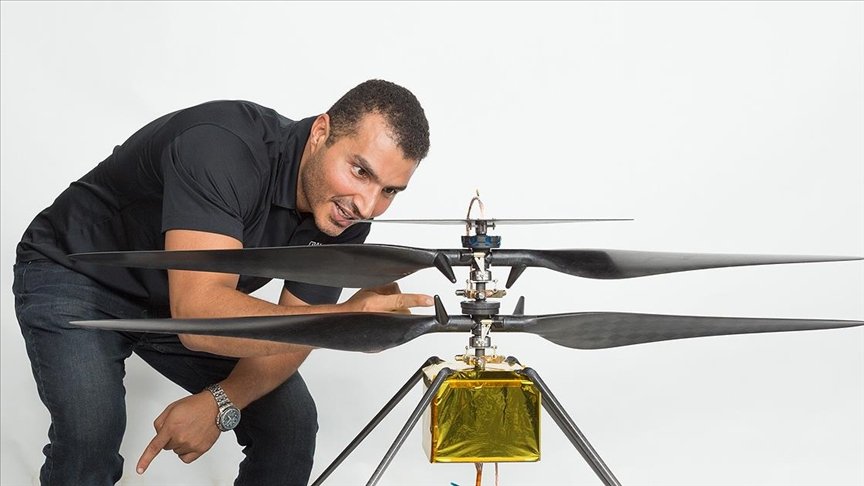
Developing the electrical systems for the Ingenuity helicopter on Mars.
Brief Background
Loay Elbasyouni was born in Germany while his father was studying medicine. He returned to Beit Hanoun in Gaza, Palestine, when he was five years old. He lived through the First Intifada, a time when the school year was reduced to just 80 days. He attended UNRWA schools for his primary and secondary education. In 1998, at the age of 20, he moved to the United States to pursue his university studies. He earned a Master's degree in Electrical Engineering from the University of Louisville in 2005.
Loay Elbasyouni was part of the NASA team that made history in April 2021 by flying the Ingenuity helicopter from the surface of Mars. He served as the Lead for Power Electronics and Power on the NASA Mars Ingenuity Helicopter team. He received multiple achievement awards for his exceptional contribution to the Mars Helicopter team, which proved the feasibility of helicopter flight in the extremely thin Martian atmosphere.
Elbasyouni has over 20 years of practical experience in power electronics, having worked across several sectors, including automotive, renewable energy, and aerospace. Recently, Loay has been working on advanced power conversion and propulsion technologies used in the development of various industries (aerospace, aviation, automotive, and semiconductor equipment).
Ingenuity is a robotic helicopter that was sent to Mars as part of the Mars 2020 mission, becoming the first aircraft to achieve controlled flight on another planet. Loay Elbasyouni's role made him responsible for:
Developing the electrical systems
Designing the motor control systems
Developing the power systems
Developing the electronic control units
Designing the internal communication systems
In his own words: "I was responsible for the motors, control systems, and electrical communications for the helicopter."
What has been accomplished?
. Achieving the first flight on another planet
Demonstrating the feasibility of flight in the Martian atmosphere
The methodology or tool used
The project relied on an advanced engineering methodology comprising space systems design, the experimental method, and mathematical modeling.
Impact or Results
The first flight on the surface of Mars was achieved in April 2021, marking a historic milestone for humanity.
Demonstrating the feasibility of flight in the Martian atmosphere—something scientists had been uncertain about due to the atmosphere's low density.
Where were the results used?
Scientific Impact: Opening a new frontier in space exploration and advancing spaceflight technologies.
Technological Impact: Developing advanced control and power systems.
Global Impact: Utilizing the findings to develop future space missions.
Societal Impact: Louay has become an inspiring global role model for youth; he was also honored by the UN agency UNRWA in recognition of his scientific achievement.
The findings are currently being applied to: designing future aircraft for Mars, developing space exploration technologies, and supporting future NASA missions.